There Are a Dozen Good YNAB Alternatives. That's Not Your Problem.
Spend ten minutes in any budgeting forum right now and you’ll see the same scene: someone announces they’re leaving YNAB, and a crowd of alternatives appears. Zero-based apps, envelope apps, manual-entry apps, self-hosted apps. Most of them are genuinely good. Several are cheaper. A few are excellent.
Here’s the question almost nobody asks before migrating: is your actual problem the budgeting app, or is it that the budget can only see money?
The two complaints that sound alike
When people say “my budgeting app isn’t working for me,” they usually mean one of two very different things.
Complaint one is about the software. The price went up. The sync broke. The interface fights you. The methodology feels rigid. If this is you, good news: the alternatives market has never been stronger. Pick one with the import path and price you want, move your data, done. You’ll be happy.
Complaint two is quieter, and it survives every migration. The budget was accurate, the categories were tidy, and the household still got surprised. The trip you were “saving for” had a category with $1,200 in it, but nobody noticed the passport needed for that trip expires in September. The insurance category was funded, but the policy’s hurricane deductible changed and nobody read the renewal. The car fund was healthy right up until the registration lapsed. The spreadsheet was right about the money and wrong about the life.
If that second complaint sounds familiar, switching budgeting apps will not fix it, because the failure was never in the budget. It was in everything the budget cannot see.
Money is downstream
A household budget treats money as the whole story. But in a real household, money is downstream of everything else: the house, the vehicles, the travel plans, the insurance policies, the documents, the family calendar. The expensive surprises rarely start as money problems. They start as an expiration date nobody tracked, a warranty nobody filed, a maintenance item nobody scheduled, and then they arrive in the budget as an emergency.
Budgeting apps are structurally unable to catch these, and it is not a flaw in their design. It is their design. A category can hold dollars. It cannot hold “the water heater warranty lapsed in March” or “the evacuation zone got redrawn” or “the trip is planned but $0 has actually been set aside.” Those facts have no dollar amount, so they have nowhere to live, so they live in someone’s memory. Memory is where household emergencies come from.
What the connected version looks like
Here is a concrete example from our own product, because it makes the difference tangible.
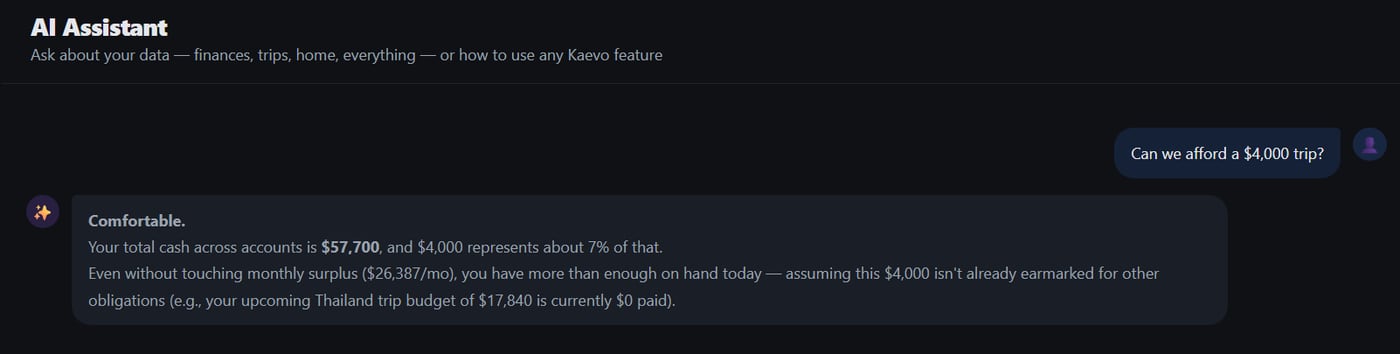
Ask a budgeting app “can we afford a $4,000 trip this fall?” and the best possible answer is a category balance and maybe a savings rate.
Ask Kaevo the same question and the answer that came back was: yes, comfortably, with the math shown, and then a caveat no budget could produce: “assuming this $4,000 isn’t already earmarked for other obligations. For example, your upcoming Thailand trip budget of $17,840 is currently $0 paid.”
That last sentence is the whole difference. The system knew about a trip that existed as a plan, not as a transaction. It cross-referenced a commitment that had never touched the budget, because in a connected household system, travel plans and budgets and documents and maintenance schedules are all one body of knowledge that the AI can reason across.
That is not a better budgeting feature. It is a different category of tool. The budget is one module inside it.
How to know which one you need
A simple test: write down the last three money surprises your household had. Not overspending, surprises. The bill you forgot existed, the renewal that jumped, the repair that “came out of nowhere.”
Now ask: would a better budgeting app have caught them? If yes, go get one of the dozen good alternatives; you will be well served. But if the honest answer is “no, because the information lived outside the budget,” then the thing you are shopping for is not a YNAB alternative at all. It is a system where the budget knows about the household around it.
That second thing is what we build. Budgeting is one module. The household is the product.
Kaevo is the AI household operating system: finances, home, travel, family, and legacy in one secure place, with an AI that reasons across all of it. Try it free for 14 days.